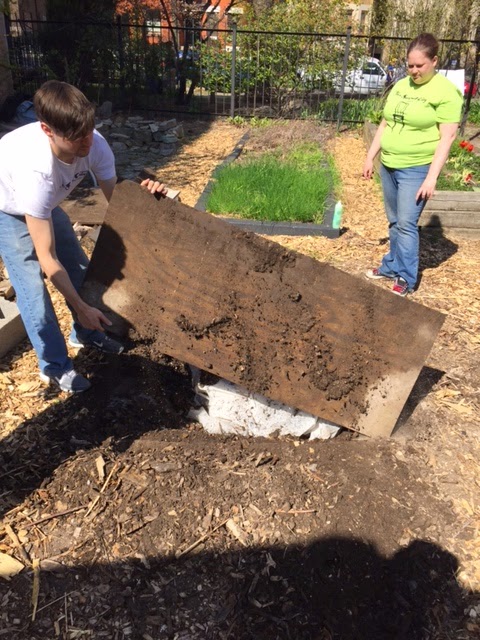
Last weekend, we unearthed the two fig trees that we had buried last fall to protect them from the Chicago winter. Michael, Ivy, and Evelyn cleared away the mounds of soil that covered the ply board roofs over the shallow trenches in which the trees had lain for the last few months. The trees emerged skeletal and leafless, their branches tipped with new growth that had the pale translucence of cave fish.
Later, when looking at photos that I had taken of the unearthing, I recognized parallels to myths of Persephone, daughter of Demeter and Zeus, and the Greek goddess of spring vegetation. As did she who ate pomegranate seeds in the underworld at the behest of her captor, Hades, our fig trees must spend the barren months buried; their return to the light, like that of Persephone to Demeter, is our personal harbinger of spring.
When I looked deeper into the story of Persephone (consulting an unusually scholarly
Wikipedia entry), other synchronicities emerged. The Minoan worship of Ariadne, a vegetation divinity who appears to be related to Persephone, featured “tree-shaking” rites. Moreover, the cult of Dionysius, the son of Persephone, is associated with the fig tree. By burying our fig trees in November and digging them back up in March or April, we had been unwittingly participating in a mini-Eleusinian mystery.
Dude! I got goosebumps
said the glancing-eyed Achaeans
the strong-greaved Achaeans
This sort of mythopoeic frisson occurs often in the garden. For example, a couple of years ago, at the height of summer, while picking tomatoes in the rosy-fingered dawn, I made a number of wholly unoriginal observations on the erotic metaphors of horticulture: the masculine sowing of seed; the feminine bearing of fruit; etc. My fellow harvester responded by pointing to the pear hanging from a branch at the top of a nearby tree and paraphrasing a fragment of Sappho:
As the sweet apple blushes on the end of the bough, the very end of the bough which gatherers missed, nay, missed not, but could not reach.
I Googled this fragment of longing later.
One source mentioned that the “sweet apple” to which the poem referred was probably a graft of an apple on a quince tree. As the tomato-picker who quoted the fragment is both a poet and an orchardist, his response appears to have been particularly appropriate.
I propose that we name the larger of our two fig trees
Persephone, and the smaller one
Kore (another name for the goddess). We may discover other myths that will suggest sobriquets for the other trees in our small Uptown Arcadia.
 On May 2 2015, two groups of volunteers worked together to complete a huge amount of work at the garden. May 2 was DePaul University's 17th Vincentian Service Day, and at least the third time that a large group of students has arrived at the garden ready to help us finish preparing it for the season. The DePaul students, many in blue, were joined by a green-clad group of volunteers from The Second City's Volunteer Team.