Sunday, May 6, 2012

indeed, it is the only thing that ever has

Last Friday, I prepared a list of tasks that we thought should be accomplished in the next couple of weeks. Anticipating a large number of volunteers from DePaul University, who would help the garden as part of its 2012 Vincentian Service Day, I made an ambitious list of 18 items, adding a number of tasks that I thought would be nice to accomplish, but probably not possible in a single work day.

I am now glad that I made the full task list. Three groups of volunteers arrived on Saturday morning: a dozen or more students from DePaul; at least eight more volunteers from the Second City Dream Team Meetup group; and a number from the large group of people who return to the garden after attending as a member of another group. (I am an alum of the latter group: after first visiting the garden with Chicago Cares in the fall of 2007, I returned the following weekend on my own and never stopped. )

At the end of the workday, we had accomplished all but two of the tasks on our list.

The DePaul students fanned across the garden, wreaking construction and order, leaving promise in their wake. They tied twine trellises for the sweet peas in beds 4 through 6.
They planted radishes (Crimson Giant; French Breakfast; Cherry; and others) in beds 7 through 9, carrots (Tonda de Parigi and Royal Chartenaux) in bed 12, and a border of marigold seeds in bed 13 for the tomato plants that will soon be transplanted there.
They pulled dead flowers and weeds from the front garden. They planted crowns of Martha Washington asparagus throughout the garden, including at the eastern end of the raspberry bed.

They built a brick walkway leading to our rain barrels. And after all of that hard work, they presented the garden with a thank you card.


The Second City folks were equally busy in the eastern part of the garden. Working in beds 15 and 16, they constructed bean tripods out of aluminum poles and trellises out of whatever they could find, including the pair of repeatedly repurposed papasan chair backs that are a personal favorite as a form of plant support. They planted seeds for three varieties of pole beans (Cherokee Trail of Tears, Sultan’s Crescent, and Bountiful) around the trellises before moving to the potato bed.

After repairing the western end of bed 22, the Second City volunteers dug a trench down the middle of the bed and planted sprouted red potato seeds. The DePaul students came along later and planted seed for a border of allysum flowers that we hope will live up to their reputation as potato companion plants.
Our third group focused on bed 19, under the Stanley plum tree. They planted a bewildering array of greens, alternating rows of rapini (broccoli raab), varieties of spinach (Bloomsdale Savoy, Bordeaux, and Monstreux de Virafloy), and Red Giant Mustard.
 Everyone wrapped the newly seeded beds with chicken-wire fencing. We planted so many rows that we ran out of plastic plant labels—a first. We wound up cutting up a couple of seed pots to make labels for some of our rows.


After only a single day of focused work, the garden was transformed from a collection of muddy beds to an array of fenced future homes of vegetables for the pantry. We are well positioned for the growing season.

Thursday, May 3, 2012

garden plan 2012

Two Sundays ago, a small group of us met to plan where we would plant for this year. Armed with guides to companion planting and knowledge of how we needed to rotate crops, we negotiated the locations of the various crops that we intended to grow. Following is the plan to which we agreed. It is subject to change as the year progresses.

Wednesday, May 2, 2012

another day, another pile

Last Thursday, John took delivery of a load of wood chips from Crosstown Tree Service. The delivery truck was too large for our gate, so the service dumped its load where it could, flooding the back area. John spent the next two hours shoveling enough to where he could barely close the back gate. To complicate matters, the new pile of wood chips partially covered the older pile of compost that we had received the week before. We had a huge and—after Friday’s rain—sodden mass of organic material that needed to be shifted.


We were thus fortunate that many volunteers arrived on Saturday morning, ready to work. In addition to a biweekly group of volunteers from Chicago Cares and a new Meetup group from Second City, a number of individuals dropped in, asking for something to do.

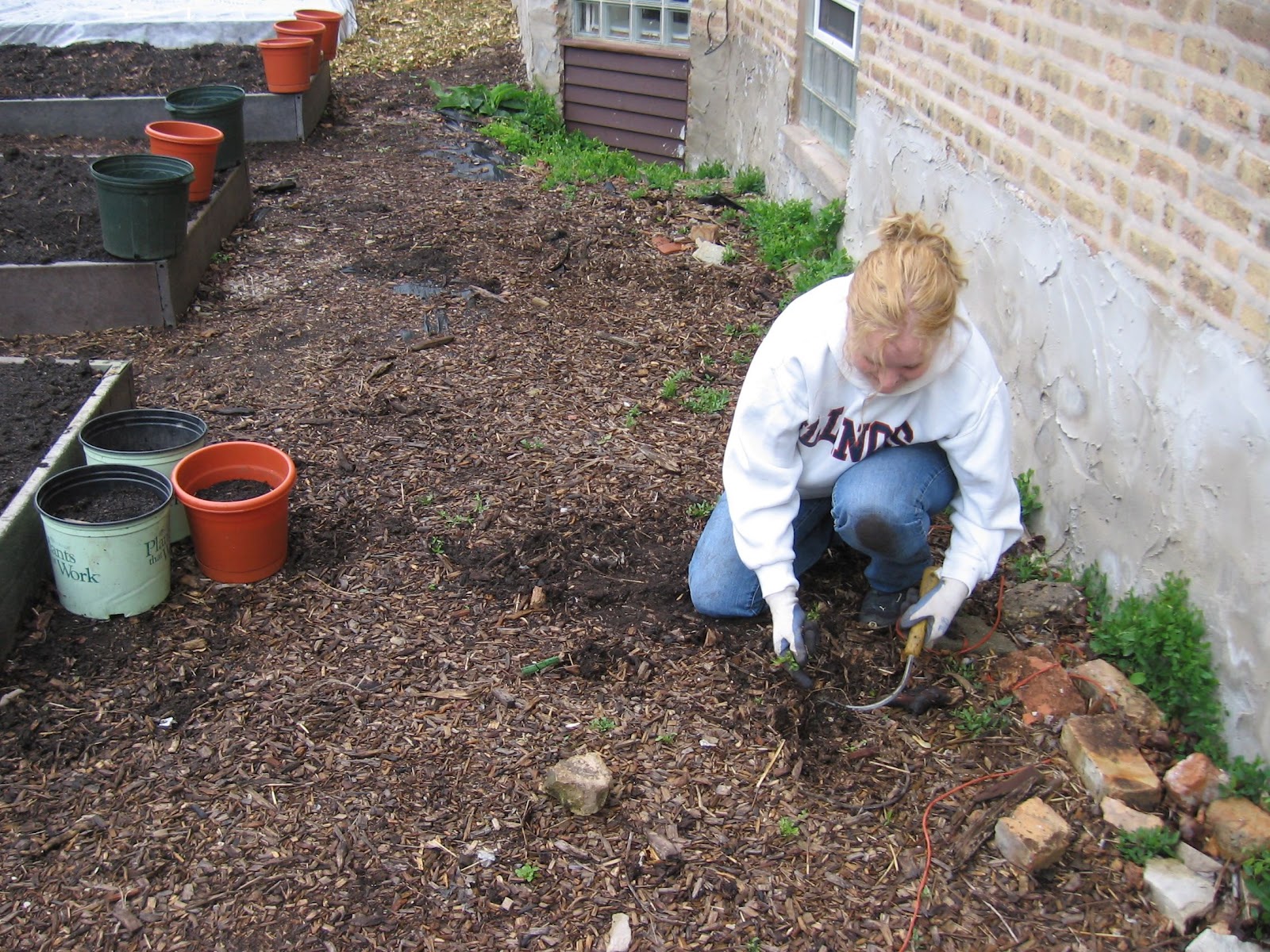
We had a list of tasks with which to occupy them. First, we had to weed the areas between the raised beds. Then, while some of us worked from one side of the pile, shoveling chips into wheelbarrows for distribution throughout the garden, others worked from the muddier side, loading wheelbarrows of compost to work into the raised beds.


By the end of the day, most of the garden was either covered with wood chips or overflowing with organic compost and thoroughly worked.


Away from all of the earth moving, a couple of us worked in the northeast corner of the garden lot, sowing sweet pea seed in containers that we arranged around the fence. We hope that the sweet pea will crowd out the bindweed that usually menaces the corner in early summer.


We did little planting on Saturday, except for sowing a “cut-and-come-again” bed of lettuce in the bathtub. Now that the pile in the back of the garden is no longer a worry, we can turn back to planting quick-growing, cool-weather crops and make use of the time before we can transplant our tomatoes and peppers.

Sunday, April 29, 2012

Recent articles that mention Ginkgo

Each year, at least one journalism student will approach members of the garden to conduct interviews and even film documentaries. We always try to oblige, answering questions and striking action poses with various farming implements: we enjoy showing people around the garden, and interviews give us a chance to refine our elevator pitches and remember why we come out every weekend.

We rarely see the results of these interviews, because most of them are apparently part of student projects; so it is nice to receive links to finished articles, such as the following:

  • In the April edition of CityMag, Rian Ervin describes the work of a number of community gardens, including Ginkgo. Ervin spoke with the Two Daves.
  • One of the Two Daves was also featured in Laura Mihelich and Anuja Vaidya's article in the March Medill Reports.

Saturday, April 28, 2012

return of Peresphone

Last weekend, we unearthed the two fig trees that we had buried last fall to protect them from the Chicago winter. Michael, Ivy, and Evelyn cleared away the mounds of soil that covered the ply board roofs over the shallow trenches in which the trees had lain for the last few months. The trees emerged skeletal and leafless, their branches tipped with new growth that had the pale translucence of cave fish.

Later, when looking at photos that I had taken of the unearthing, I recognized parallels to myths of Persephone, daughter of Demeter and Zeus, and the Greek goddess of spring vegetation. As did she who ate pomegranate seeds in the underworld at the behest of her captor, Hades, our fig trees must spend the barren months buried; their return to the light, like that of Persephone to Demeter, is our personal harbinger of spring.

When I looked deeper into the story of Persephone (consulting an unusually scholarly Wikipedia entry), other synchronicities emerged. The Minoan worship of Ariadne, a vegetation divinity who appears to be related to Persephone, featured “tree-shaking” rites. Moreover, the cult of Dionysius, the son of Persephone, is associated with the fig tree. By burying our fig trees in November and digging them back up in March or April, we had been unwittingly participating in a mini-Eleusinian mystery.
Dude! I got goosebumps
said the glancing-eyed Achaeans
the strong-greaved Achaeans
This sort of mythopoeic frisson occurs often in the garden. For example, a couple of years ago, at the height of summer, while picking tomatoes in the rosy-fingered dawn, I made a number of wholly unoriginal observations on the erotic metaphors of horticulture: the masculine sowing of seed; the feminine bearing of fruit; etc. My fellow harvester responded by pointing to the pear hanging from a branch at the top of a nearby tree and paraphrasing a fragment of Sappho:

As the sweet apple blushes on the end of the bough, the very end of the bough which gatherers missed, nay, missed not, but could not reach. 

I Googled this fragment of longing later. One source mentioned that the “sweet apple” to which the poem referred was probably a graft of an apple on a quince tree. As the tomato-picker who quoted the fragment is both a poet and an orchardist, his response appears to have been particularly appropriate.


I propose that we name the larger of our two fig trees Persephone, and the smaller one Kore (another name for the goddess). We may discover other myths that will suggest sobriquets for the other trees in our small Uptown Arcadia.

Monday, April 23, 2012

composting and seeding

On the weekend of April 22, we were joined by a number of volunteers, including a group of young women from the Young Women Warriors program of the Chinese Mutual Aid Society and students from the DePaul Oxfam Association. The day’s focus was on making the best use of our imported compost, and trying to get something in the ground. The risk of frost seems low. In the few weeks before the seedlings at the greenhouse are ready to transplant, we may have time to grow a quick crop of peas, greens, and radishes.

We started by piling up compost in shallow berms between our fruit trees, taking care not to get the soil too near the tree’s roots.


We next worked a few barrows’ worth of compost into the beds in the northwest corner of the garden, into which we planned to direct-sow seed. We worked sand and compost into the carrot bed in the middle of the plot, leavening the soil so that our carrots would grow straight.

[The Friday before the workday, I had worried that we did not have enough seeds for cool-weather crops, so I went to Gethsemane Garden Center. (There are three types of stores that enable ambitions of agency in the susceptible: book stores, hardware stores, and garden-supply stores.) After a sustained impulse buy, I walked out of Gethsemane with a paper sack full of seminal potential.]

Once the beds had been prepared, a number of us planted. We alternated rows of peas (Cascadian and Super Sugar Snap) with those of radishes (Crimson Giant), spinach (Lavewa and Bloomsdale), and lettuce (Bronze Arrowhead and Freckles). We also planted a variety of carrots in the carrot bed.


Other volunteers tied back the rose bushes and layered compost in the bins. With the aid of our new compost thermometer (another gift from Chicago Cares), we could see that our bins are still too cold. Our bins need a proper layering of carbonaceous (brown) and nitrogenous (green) materials to achieve an environment that encourages the microbial activity that turns detritus into dirt.


Finally, we watered our freshly-sown beds from the rain barrels and covered the beds with new sheets of row cover.

Saturday, April 14, 2012

Convergence

You know that feeling you get when you arrive at the garden and 10 yards of organic leaf compost confront you like a sleepy cow resting on her haunches in the middle of the road, but then you realize that an unprecedented amount of volunteers have shown up to help spread it? No? Well, whatever... it's a great feeling.Because our yield was a little light last year we decided to import some fresh compost to amend our beds before we start planting. No disrespect to our compost bins, they're beautiful, but we just needed a little boost.But before we could spread the compost we had to weed the beds. Luckily, today was our first Chicago Cares volunteer day of the season. Chicago Cares, a group that organizes volunteer projects for curious Chicagoans, lends time and manpower to the garden regularly throughout the season and on days like today we cannot be more thankful.
In addition to the Chicago Cares volunteers, we also had some repeat visitors from Second City and they brought friends! It's rare to see the garden so busy, but thanks to so many hands we made short shrift of the weeding and started turning the cover crop (green manure) into the earth to get all that nitrogenous goodness into our beds.
Each bed got a healthy serving of the new compost and people got to work raking and shoveling.


And, as if we weren't already bowled over by the array of visitors to the garden, we got a special treat. Karen, one of the ORIGINAL Ginkgo founders, dropped by! I'm starting my third season with Ginkgo and I'm constantly amazed by the garden's history. When the garden was started in 1994 the neighborhood was a totally different place and there was nothing on the lot except for a Ginkgo tree and debris. The founders laid the foundations, built the beds, and started something that has grown beyond any expectation. Karen reminisced about what the garden looked like when she was there. Even our longest serving volunteers weren't around to see some of the things she talked about, so it was great to hear. She remembered learning to use a sledge hammer, and when the wrought iron fence was still a chain-link fence. Karen posed under the cherry tree and told us that it was originally from a plant sale at Marshall Fields! Imagining this beautiful unruly centerpiece as a knee-high potted plant in the back of someone's car was a truly profound lesson in the meaning of "grass roots". Stay tuned if you look forward to more of Ginkgo's story!