Monday, October 21, 2013

i love a parade (June through August)


One benefit of being remiss with regular blog updates is that I get to post an entire season's pictures at once. Following are photos of the bike cart as it became increasingly laden through the season, as well as the how the garden's produce appeared after I arranged it for the pantry.

The pantry volunteers have started to tease me about the growing fussiness with which I market the fruit and vegetables from the garden. I now do everything except photograph a handful of tomatoes being tossed through a sheet of water.

June 1 - radishes and flowering chives


June 8 - radishes and greens

June 15 - greens, peas, roses, and flowering herbs


June 22: It is not until you grow oregano that you realize how lovely the herb is in flower.


June 29 - The greens begin to arrive in earnest.


July 6 - Our boxes stack three high in the delivery cart.

July 13 - Greens, radishes, raspberries, and peas begin to crowd the market cart.


July 20 - Kale and collards are the quiet folk at the party over whose shoulders everyone peers, wondering when the tomatoes will show. They'll stay around and help rearrange the furniture long after the tomatoes have moved on to the next thing.


July 27 - Heads of lettuce, kale, beets, gooseberries, and the first of (frustratingly) only a half dozen heads of broccoli that we will eventually harvest this season. An hour before these pictures were taken, these vegetables and fruit were still in the ground or on a bush.


August 3 - Nearly 20 pounds of kale and other greens are overshadowed by a small basket's worth of cherry tomatoes.


August 10 - Our harvest has started to diversify, with beans, turnips, and carrots joining the weekly bounty of greens. Sick of the way that the wandering onions were taking over part of the garden, we harvested them all. They taste similar to shallots.


August 17 - Artichokes, beans, tomatoes, purple carrots, chard, kale, collards, and garlic chives


August 24 - Pole and bush beans, tomatoes, cabbages, and the stalwart kale


August 31 -  Tigger melons, the first apples of the year, a few cucumbers, and our kale and collards. Of more interest, of course, are the tomatoes.


Thursday, October 3, 2013

Ye been the salt of the erthe and the savour.


At around 8:30 every Saturday morning from Easter to Thanksgiving, a volunteer unlocks the gate at the front entrance to the garden, turns on the water, and sets out buckets of gloves and hand tools. Eventually, other volunteers join her: sometimes, they trickle in individually, quietly stowing their backpacks under the shed before immersing themselves in the tomato bushes; other times, large groups bustle in, bearing coffee and sign-up sheets, wearing matching T-shirts.

 
April 13 2013 - Chicago Cares


May 5 2013 - DePaul Vincentian Day of Service

May 5 2013 - with Second City

We never know what kind of help we’ll get on a Saturday. Each workday is an aleatoric composition of community gardening, performed with Cobraheads and rakes instead of detuned pianos. A workday may involve a handful of poncho-clad folks hunched over muddy beds, or it could be swirl of the summer-besotted, clamoring for task assignments. We have had as few as three volunteers and as many as thirty.
June 1 2013 - with Second City

June 8 2013 - with Chicago Cares and Second City

June 15 2013 - with Second City

June 22 2013 - with Chicago Cares and Buena Park neighbors

June 29 2013 - with Buena Park neighbors


The tasks we complete depend on the people who choose to join us. When our ranks are small, we focus on getting the harvest ready for delivery; when flush with willing workers, we expand to tackling bindweed and cutting up branches for compost.


July 6 2013


July 20 2013 - with Chicago Cares and Buena Park neighbors
 
The elements common to our horticultural jam sessions are energy and compassion. I continue to be surprised by how hard so many people work to grow and harvest food that they will never themselves consume, but give freely to people who they may never meet. 

August 3 2013 - with Second City

August 10 2013 - with Chicago Cares and Second City

August 24 2013 - with Chicago Cares

August 31 2013 - with John (center), an Irishman who stopped by during his travels around the world, volunteering with organic gardens

September 7 2013 - with Americorps

September 14 2013 - with Chicago Cares, Loyola, UIC, and Second City


September 21 2013 - with Entertainment Cruises

 
October 5 2013 - with Chicago Collegiate Scholars

October 12 2013 - with Chicago Cares

October 19 2013 - with Chicago Collegiate Scholars

Wednesday, September 25, 2013

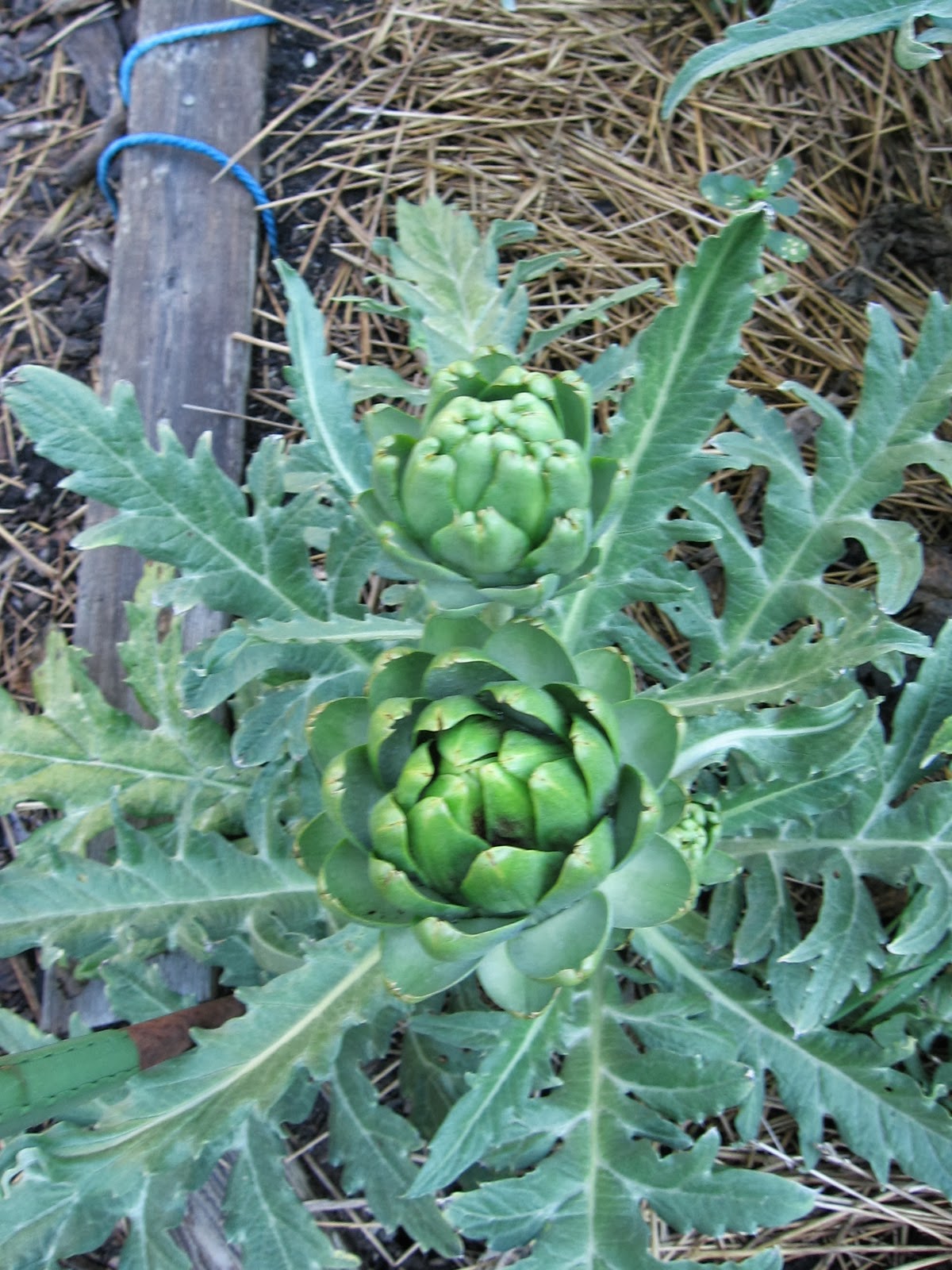
Surprise of 2013: artichokes


We have tried to grow artichokes at least twice in the last five years, without success. We understood that artichokes required a lot of heat and sunlight to grow; we suspected that our garden just wasn't warm enough. That didn't explain why the artichokes in the demonstration gardens of the Chicago Botanical Gardens seemed to thrive.

This year, we gave artichokes another shot, planting a few starts in the "dodecahedron" bed in the northeast corner of the garden. By June, the starts had grown to the point where they usually stopped in our garden.

June 15

June 22

To our surprise, the plants kept growing. By late July, a number of rosettes strained towards the sun.

July 27

August 3


In early August, some of the artichoke blooms started to turn purple and open. We had to consult sources to determine when was the best time to harvest these unexpected vegetables; we'd never gotten this far before.


August 10


We harvested the largest of the artichokes and brought them to the pantry, hoping that someone there would know how to prepare them.
August 17


In early September, we were able to harvest a second round of artichokes.
August 31
As of September 21, the artichoke plants had no more fruit to harvest, but still thrived.

Artichokes are perennial plants; now that ours are established in the dodecahedron bed, we can expect another harvest of globes next year.


Tuesday, August 27, 2013

Seed saving tomatoes and Tigger melon

These are going up late, but enjoy some photos of tomatoes and tigger melon!


Oh! And this awesome apple!

Monday, August 26, 2013

Welcome Summer!

Wow things got busy there!  Growing season is in full swing, tomatoes are changing color, and any complaints about the mild weather are down the drain.  Many use the swelter as an excuse to stay in their own homes, drinking iced beverages, spread eagle in front of box fans, or locked tightly in cryogenic air conditioned rooms, refraining from all movement but for the weak laconic movement of one's tongue and lips to the oasis of unsweetened iced tea, but we see the real troopers at Ginkgo.  We see those that have conditioned their eyebrows into retention ponds.  Our volunteers apply and reapply sunblock, because really... tomatoes look better red than we do.  Some of them say "to heck with it!" and in rude defiance of the Sun's omnipotence, wear sleeves and long pants.


The fact that pumpkin flavored beers have already emerged on the market is proof that our seasons are out of whack, but we have begun harvesting some delicios apples, including this red fleshed variety.  Any visitors or volunteers to the garden know that this one is among our favorites.  Why?  It's not an apple that we intended to grow.  In short... apples do not grow "true to seed", but instead are propagated by graft.  Growers take the rootstock of an apple that is know to have great roots in one's selected growing site and they choose an apple variety that they favor to attach to the rootstock.  At Ginkgo we did what every other apple grower has done since, well... since a long time.  What happened next was a surprise bit of fortune.  A rabbit girdled the tree, completely chewing away the bark around the base of the tree, essentially strangling the grafted shoot.  At this point, somebody should have pulled the tree out and tried again, but no one did and instead, the rootstock, identified as Budagovsky 9, grew shoots and began bearing fruit.  Delicious, tart, apples with wildly pink and red flesh.  Yum.

Without further ado, this is what we've been up to:

Budagovsky 9

Our best volunteers have been building a new set of compost bins out of our old fence.


That's what we like to see!

Our plums have survived World War Aphid and are less than a couple of weeks away from ripe.

These giants have really become the stars of the garden.  Think about the size of a sunflower seed.  I'm in awe.