Showing posts with label chard. Show all posts

Tuesday, August 18, 2009

Transporticulture

Saturday afternoon the Active Transportation Alliance brought a whole slew of bicyclers for their annual Veggie Bike and Dine.

Veloship:


Folks were effusive about how great the garden looked – which, although we appreciated the sentiment, surprised us. We thought it looked awfully defoliated since earlier that day we'd harvested another 117.2 pounds for donation! Tomatoes and peppers are definitely coming in, but the big bumper crops were cucumbers and squashes. We also harvested swiss chard, kale, collards, beets, radishes, broad beans, bush beans, potatoes, basil, and handful of daikon.

Reviewing the data:


Late August and early September is the time of year with the biggest harvests! Come by and see how we're doing!

Note: Photos are courtesy and copyright of Arline Welty (top) and Katie Schuering (bottom).

Thursday, June 25, 2009

Summer has arrived...at last!

On what felt like the real first day of summer, June 20, a large team of volunteers harvested 31 pounds of veggies, primarily greens (collards, chard, spinach, lettuce and mustard), but there were 4 pounds of turnips (finally!), a handful of daikon and chives, sage and mint.

It was a hot day, so after harvesting and rinsing the greens, the beds all needed a thorough watering. We’re finally seeing some flowers on the tomatoes, a positive sign of things to come. And the other veggies all seem to have benefited from the recent rain and warmer temperatures.

Here are the beans getting ready to grab onto the papasan:


The sky was cloudless and the sun was bright and the temperature was hot, so it was a good thing we’d planned a potluck for the afternoon. The reason for the potluck was to wish super-volunteer Lara well as she departs Chicago for Pittsburgh.


Lara’s been a regular volunteer for a few years, and her expertise and help will be missed. But she’ll have her own garden in Pittsburgh and she’s actually taking an heirloom tomato plant with her to get her new garden started off right.

One of the highlights (among many) of the potluck was a salad made from a selection of different greens and herbs from the garden. And the two watermelons certainly hit the right spot. The newly built patio provided the perfect shady place to eat and chat.


A man in a hat seeking answers to the garden's challenges in the shade of the shed earlier in the day:

Saturday, June 6, 2009

Wine caps and prairie dropseed

On Saturday June 6, Ginkgo hosted a happy bunch of enthusiastic volunteers (including a Chicago Cares crew), who tirelessly harvested, weeded, sowed, planted and mulched things into order.


Our second harvest of the season included the rest of the radishes, more spinach, chard, collards and kale, two heads of lettuce, and assorted herbs.
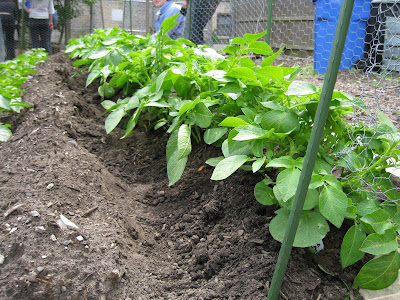
La Ratte fingerling potatoes

With the harvest in, we moved on to various maintenance activities. One team earthed up the La Ratte fingerling potatoes (half a bed, plus the overflow in pots and the bathtub). The principle is to raise the soil around the growing potato plants to encourage them to generate more roots and less foliage.

Ginkgo founders Eric, Shona, and daughter


Another team tidied the raspberry canes. And given the continued cool nights, we also blanketed the sweet potatoes with row cover. Much weeding was done in many locations. Benefiting from the advice of Ginkgo co-founder Eric, in town for a rare visit, we mustered enough courage to take out the sickly old boughs of the smoke tree to the left of the front gate, in the hope that some of the healthy shoots at the base will produce strong new trunks.

In a re-enactment of a scene from My Ántonia we also dispatched volunteers to trade growing stock with neighboring homesteads. Alan returned first of all with a bountiful selection of unusual varieties of organic tomatoes from Rogers Park. We needed these to supplement our home-grown plants which have struggled in this spring's cold and damp.

Meanwhile, Doug trekked across the flatlands to Barrington to pick up the long awaited allotment of prairie plants from Native Seed Gardeners, a seed saving program associated with the the Chicago Botanic Garden. I think we had all envisaged getting something more than the six small plugs that they were able offer us. Apparently they have received lots of interest from local gardeners in their program, which is great. However, it looks like we set our expectations a little high. We're definitely going to need to purchase many more plants if we're ever going to have anything like a prairie garden.


Undeterred, we made a start on increasing our prairie plantstock by sowing Echinacea purpurea (purple coneflower), Echninacea angustifolia (prairie coneflower) and Rudbeckia hirta (one of the many plants called black-eyed susan) in parts of three beds at the west end of the garden.


Back with the vegetables, three of the remaining beds were quickly consumed by all sorts of squash: zucchini, acorn squash, two types of pumpkins, and Armenian cucumbers (strictly speaking, a weird melon). In the next bed, we finally discovered a use for the reclaimed papasan frame which has now been repurposed as a climbing frame for pole beans.

We finished up the session by inoculating our first bed for Wine Cap stropharia mushrooms. We're going to take two approaches with these. Today's was to mix half the sawdust spawn into a dampened 4-inch deep bed of 75% wood chips and 25% compost, spread out under one of the plum trees. With some more compost/chips mixture on top and a light straw mulch, this should provide the ideal growing medium. Next week, we'll try the other approach, inoculating a bed of pre-soaked straw.


[Photos courtesy of Dave Short]

Friday, June 5, 2009

The first harvest is in!

On Saturday, May 30, Ginkgo Organic Gardens had its first harvest of the season! Volunteers harvested collards, kale, chard, spinach, radishes, chives and mint. All were transported to Vital Bridges and happily received.

The greens, especially the collards, are always especially popular. Starting them in the greenhouse this year gave them a good headstart and meant we were able to harvest earlier than last season. The collards had a long growing season last year, continuing well into the fall. (They prefer cooler weather.) It will be interesting to see whether starting them in the greenhouse has any effect on the length of their season.

During Thursday's evening session, planning was done for the few beds that are still empty. We've now made room in the schedule (and the beds) for cucumbers, winter squash, summer squash and some heirloom tomatoes. Beans and eggplant will share a bed. Lettuce will share a bed with soy. Artichokes will share the sweet potato bed.

There will be a lot of planting to do on Saturday.

...and there is still more creeping buttercup to be dealt with....It has sprouted all over the neighborhood this season.

Friday, May 29, 2009

Is summer finally on the way?

The garden welcomed a large crew of volunteers on a beautifully sunny holiday Saturday, May 23, to seed, weed, water, harvest and transplant.

The ornamental alliums (members of the onion family) in the front garden are fully in bloom now. Unfortunately, a few were snapped by the wind. These were cut and made into a bouquet for one lucky volunteer. Also unfortunately, there was a lot of trash in the front garden, which was picked up by the bravest volunteers.


A new wildflower bed was seeded next to the new patio.

Onions, pole beans and snap peas were sowed in the large dodecagonal bed. Bush beans and soy beans were sowed in half of a nearby bed.

The fava beans sowed earlier in the dodecagonal bed are looking happy.


And the radishes in that same bed continue to flourish.


Swiss chard was moved from the cold frame and transplanted into new beds.


Unfortunately, the tomato plants suffered a bit from the wind earlier in the week. They were looking a bit beaten down. Hopefully, the thorough watering they got on Saturday, and the sun over the weekend, will help them toughen up a bit.

The herb bed is rather full, so cumin and tarragon were started in pots. Chives and mint continue to proliferate and be harvested.

Creeping buttercup had taken over about three-quarters of one of the flower beds, so a team of three spent a good long time weeding, but only managed to get about halfway finished. Creeping buttercup is a nice looking plant with its serrated, variegated leaves and bright buttercup flowers, but it was strangling the sedum and everything else that might want to be coming up in that bed later.

We’re looking forward to lots of transplanting (and a lot less weeding) next week. The sweet peppers and the hot peppers are spending their last week in the cold frame, just to be safe.

...and the wood chips from the city finally arrived! They were spread throughout the garden to help keep down weeds.

With thanks to Evelyn Y. (again), who seems to have become our unofficial photographer.

Monday, May 4, 2009

Our (volunteer) workers' day

We had a beautiful warm spring day on Saturday May 2 to welcome a willing crew of volunteers from Chicago Cares (Thanks, Stephanie -- the brownies were especially good) and the neighborhood for our very own May Day celebration. With such good weather we managed to make progress on a wide range of tasks throughout the garden.

On the cultivation front, we planted all the greens that have been growing at Kilbourn Greenhouse for the last seven weeks (collards, kale, cabbage and chard). We also trained the raspberry canes in arches over their new wire supports, which should make picking a little easier. The smaller variety of seed potatoes (La Ratte fingerlings) had sprouted well, so we planted these in our newly built potato bed, and with many left over we also filled a bunch of containers and the bath tub (that will be an interesting experiment!).

In the dodecagonal bed, we sowed the last remaining outer portion with turnips. The temperature in this bed measured 59F, so we decided to hold off another week on sowing pole beans or snow peas as these seem to prefer 60F and above.

We also made progress on a couple of long-planned infrastructure projects. Alan and some Chicago Cares folks shifted the huge rock pile to the south-east corner of the garden and laid a new patio area, surrounded by a low stone bench on two sides. The idea is to use this shady, unproductive area as a place to work in the heat of the summer on such tasks as weighing and packing produce. We're hoping we can also create a pergola for some more vines.

The new patio under construction

A separate crew attacked the flaking paint on the benches in the demonstration garden next to the street. The idea here is to coat these with a soy-based sealer, rather than repaint them. But first we need to remove a lot of green paint. Lots of elbow grease was translated into clear progress on these. There's still a little work to do, but the improvement is obvious.

A newly sanded bench in the front garden

We also had a chance to talk to a local contractor about options for fixing the drainage problems in our delivery and loading area, perhaps by diverting the runoff into a rain garden in the area previously occupied by the rock pile. It's clear that we'll need to raise the area by the gate substantially. The contractor gave us some useful ideas about permeable drainage layers and pavers that we could use in this area. We're hoping to get a quote within the week, so that we can put together a budget and apply for a grant. Undoubtedly, doing this properly is going to cost some money.

The last of our bulbs are still brightening the front garden.

Grape hyacinth (muscari)


In our herb beds, chives, thyme, sage and mint are all coming back strongly.

Chives

Thyme

Sage

Mint

Monday, March 23, 2009

A week's a long time for a Brassica seedling

Collards and dwarf Siberian kale seedlings, 7 days after sowing
A visit to Kilbourn Greenhouse to water our seed trays on Saturday 3/21 showed that many of the greens have already sprouted, just seven days after sowing. Almost every collard seed has become a sprout, along with most of the dwarf Siberian kale (but none of the red Russian kale), and a smattering of Winningstadt cabbage and rhubarb Swiss chard (but none of the rainbow chard).

Herb seedlings (not ours) under grow lights
Kirsten now has three huge arrays of grow lights in place, suspended from pulleys and hooked up to AC. Underneath, a massed phalanx of herb seedlings are reaching for their ersatz sun.