Showing posts with label pears. Show all posts

Monday, May 9, 2011

A Planting We Will Go

A cloudy morning did not stop more planting at Ginkgo on our first Saturday in May. A solid group of new and returning volunteers sprinkled wildflower seeds in the front beds along the sidewalk while Dave, Annie, Susan, and Alan sketched out our morning plans. We will be looking for marigolds, alyssums, sunflowers, and more in the upcoming weeks!


weeding and seeding the flower beds in front

The potatoes and turnips sowed the week before received some TLC next. John planted more alyssum flowers around the potato plants to naturally ward off any Colorado potato beetles. Rounds of watering the seedlings followed. Many thanks to our rain barrel for stepping up while our hose remains out of commission for a few more weeks!


planting pea seeds
Cucumbers, beans, squash, and peas were next on the agenda. First, teams split up to weed and set up trellises for our spindling plants. Through a collaborative group effort, new seeds were sown before any rain could fall.


planting pole bean seeds


planting summer squash seeds in mounds


Cosimo was good at pruning and charged little.- Calvino, The Baron in the Trees


Our fruit trees were not left neglected this weekend either. Dave climbed up our pear tree with ease to prune vertical branches that will not bear fruit.

Its white blossoms are open and have us crossing our fingers for a bountiful fruit harvest this year from all of our trees!

Saturday, April 24, 2010

The growing is starting

It was a busy and productive day thanks to all the volunteers who showed up.

And thanks to the mild weather, some tiny spinach seedlings have already started to appear.


As have some peas.


Kale and collards — started in the greenhouse at the end of March — were planted in a couple of beds. And, owing to the fickleness of Chicago weather, row cover was draped over the beds in case the temperature drops.


A number of volunteers spent time thinning the blossoms on the pear trees to prevent the spread of disease and to encourage bigger, better fruit.


These industrious folk are finding a route for the hose under the shed and along the back of the garden, out to the front garden, ready to be hooked up once the city turn on the water.


And the cold frame is set up and ready to go for when it's time to bring the peppers over from the greenhouse. We're still having some cool nights, so it's a little too soon for them to join the party in the garden.


(And this blogger apologizes for the lateness of recent postings; they were delayed due to computer crashes and thesis-writing! Things, however, are looking up.)

Friday, September 18, 2009

Our bumper harvest

After the cool summer of 2009, which slowed the growth of some of the warmth-loving veggies, we're finally hitting peak production.

On Saturday, September 12 we welcomed volunteers from Chicago Cares and with their help, picked a total of 212 pounds of fruit and veg to donate to Vital Bridges' Groceryland food pantry.

We also saved seeds from about 15 tomato varieties for planting next year, and rounded out the day with a pot-luck to send off our star volunteer, John Cahill, who is moving to Massachusetts.

Our haul this week included two crates of pears, 60 pounds of plums (two crates like the one below)


48 pounds of tomatoes, our first really red bell peppers


pumpkins, cucumbers, patty-pan squash, collards, kale, and a host of other goodies.

With the harvest picked and heading off to Vital Bridges, we turned to a few seasonal tasks. One group picked herbs for drying, another scraped paint off benches in the front garden (we'll seal these with soy sealer before the weather gets too wet), and others weeded the more recently sown beds.

After a while, we brought everyone together to help with saving tomato seeds from some of the varieties we grew this year. We started by assembling a collection of some of the weirdest, most prolific and best tasting fruits known to homo chicagoensis.

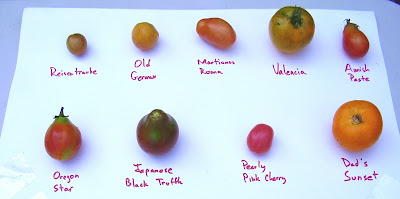


Then we assembled a fine collection of willing volunteers and instructed them in the simple art of saving tomato seeds. You start by selecting a fully ripe tomato from a variety you enjoyed. Then you slice it vertically into chunks and separate the seeds from the flesh in a bowl of clean water.


Unbelievably, one of our longer-serving volunteers then instructed people to take the tomato flesh and throw it in the compost pile. It took a particularly smart Chicago Cares volunteer to come up with the bright idea of just eating the leftover tomatoes, instead.

Then, the next task is to strain the water off the seeds. Our makeshift solution for this was a mesh floored seed tray that has been sitting behind the shed for as long as we can remember.


After that we scraped each variety of seeds into it's own small pot to begin the only slightly counter-intuitive part of the process: fermenting the seeds for 3-7 days in order to rot away the gel coating on each one. The gel contains a chemical that suppresses germination, so it has to be removed before the seed can be dried and stored. The seed pots have to be fermented until they have a thick coat of mold on the surface. But at the start of the process, they look pretty appealing:


We finished up the day with a pot-luck send-off for John Cahill, volunteer, writer and former carpenter. We wish him well in Massachusetts. (Check out those garden-grown tomatoes, basil and sorrel upon which we feasted!)


Monday, September 7, 2009

Fun with fungi


I don’t think anyone at Ginkgo really believed it at first, but we picked our first crop of wine cap mushrooms (Stropharia rugosoannulata) on Saturday September 5. There was no sign of these on Tuesday September 1, but two days later our Thursday watering team had noticed a sizeable crop mushrooming from the bed under the plum tree where we had spread inoculated straw on June 19. Not being any kind of mushroom experts, we took care to create a spore print to confirm that we really had what we expected and weren’t going to be flooding local emergency rooms. As expected, the caps released a fine film of dark purple/brown spores.


By Saturday, we had wine caps everywhere in the straw bed, but none in the woodchip bed next to it. We had read that wine caps’ favorite food was hardwood chips, but it may be that the bed with the chips hasn’t been as damp as the straw bed, or not quite the right temperature. We decided that as this was our very first mushroom crop, we should volunteer for the role of official food tasters. OK, maybe the decision to barbecue the first week’s crop wasn’t entirely selfless. A quarter hour of rummaging through the straw produced a crop of maybe 3 pounds of mushrooms (we were so eager to clean and grill them that we never weighed them properly.) We barbecued most of the crop (sprinkled with olive oil and herbs), along with a couple of peppers and our last onion.


I think all the tasters were pretty satisfied with the flavor, and so far there have been no reports of illness.


Most of the crops we grow at Ginkgo are productive over the span of several weeks. We always have to decide what’s ripe enough to pick now, and what will last another week. With mushrooms this timescale is really compressed. It only take a couple of days for a wine cap to go from a tiny button, through the most tasty domed stage, to a mature, slightly upturned cap. Equally, it’s hard to predict how long a particular “flush” of mushrooms will last. It’s going to be a challenge to time our harvests to get fresh mushrooms to the Groceryland food pantry.

Before the mushroom harvest, we did pick our regular selection of veg and fruit, including two nicely golden pumpkins, a small flotilla of patty-pan spaceships and one of the few cabbages that made it this far.


And the tomato harvest is still strong, with 38 pounds picked this week.


Several of our fruit trees are drooping under the weight of ripening fruit. We picked a crateful of pears this week, to finish ripening off the tree. And our plums look like they'll be ready next week.


We're also enjoying the largely random selection of wildflowers that have fought their way to maturity in the new bed at the end of our patio area.