Saturday, April 3, 2010

Tomato planting at the greenhouse

Dave Sny and Megan and Michael biked and bused it over to the greenhouse to make sure the tomatoes got planted. Somehow, the rest of us wimped out. Thanks for picking up the slack, y'all.

They planted a bumper crop of heirloom tomatoes (which means we'll be able to save seeds from this year's crop to plant next year).

To check out what these gorgeous tomatoes look like, see our earlier post.
  • Oxheart
  • Japanese black truffle
  • Orange banana
  • Brandywine
  • Fireworks
  • Oregon star
  • Koralik
  • Amish paste
  • Fruity cherry
  • Rutger
  • Dad's sunset
  • Fox cherry
  • Cherokee purple
  • Pearly pink cherry
  • Purple calabash (a garden favorite)

Sunday, March 28, 2010

Planting continues...

In addition to saying hello to the greenhouse cat, this week we planted several trays of hot peppers and sweet bell peppers. (Those marked with * are varieties sown from seed saved by Ginkgo — that is, we didn’t buy the seeds, we saved them from plants grown in previous years.)

Sweet bell peppers
  • Bull Nose
  • King of the North
  • Wisconsin Lakes
  • Yankee Bell [not grown in 2009]
  • *Orion [not grown in 2009]

Medium-hot peppers
  • Poblano
  • Jalapeño

Hot peppers
  • *Thai Hot
  • *Red Rocoto (a Peruvian variety)
  • *Aji Cristal
  • *Yellow Mushroom and *Red Mushroom
  • *Fish
  • Habañero

We’re going to wait a week before sowing the tomatoes. Last season we sowed them a little early, they got spindly, and once they were planted at the garden a windstorm hit, destroying many of them. We’re trying to learn from our mistakes.

Saturday, March 20, 2010

We’re starting to plant!

Thanks once again to our friend Kirsten Akre, who runs three organic greenhouses for the Chicago Park District, Ginkgo has been able to get a headstart on seed-sowing this year. This was a great help for the 2009 season: we were able to take strong, happy plants to the garden once the danger of frost had passed (which in Chicago is, surprisingly, mid-May) instead of just beginning to sow seeds directly in the ground then. And, of course, despite having had a mild week, it was sleeting and snowing on our first Saturday in the greenhouse.

Nonetheless, we started by planting our ever-popular greens:
  • Georgia (southern) collards
  • Rhubarb swiss chard (red)
  • Red Russian kale
  • Dwarf Siberian kale
  • Dinosaur kale [not planted in 2009]
  • Winningstadt cabbage
  • Utah celery [not planted in 2009]

And we also planted some herbs:
  • Cilantro
  • Sweet basil (some labeled Genovese and some not)
  • Dark purple opal basil
  • Tarragon
  • Italian dark green parsley

Kirsten and her volunteers had already started trays and trays of seeds in anticipation of Kilbourn Park’s annual organic plant sale (May 15-16). It was very inspiring to see how well her plants were already doing.

Wednesday, January 20, 2010

Weather

July 18th, 2009
January 10th, 2010

[Chicago's] changes in weather are often sudden and pronounced, but usually are of such a character as to have a stimulating effect upon the average person of health; and it is not at all improbable that the great energy of its people, which has resulted in the rapid upbuilding of Chicago, is due largely to the peculiar nature of its climate.

(Cox, Henry J. and John Howard Armington. The Weather and Climate of Chicago. The University of Chicago Press, 1914.)

Thursday, January 14, 2010

White on white

Winter in Chicago is like living in a Kazimir Malevich painting. We took the opportunity last Sunday to remove a little white from white and, by shoveling, hopefully making it a little bit more like a Franz Kline.


There isn't much to do in winter. A lot of folks think the garden looks barren but I appreciate the tidy beauty of it, like a fresh canvas waiting for the next year's palate of browns and greens and yellows.


That said, we did a little pruning of the fruit trees (January is a good time to take off branches since dormant trees concentrate their energy in the trunk) and removed some wasp nests from the shed. We kept looking around for more to do but there wasn't much. It's hard for a gardener to hibernate.

Friday, November 27, 2009

Where did the season go?

October and November have rolled by in quite a flash at Ginkgo, with a bunch of fall harvests, some seasonal fun and the end-of-season tasks to put the garden to bed.

Strangely, Nature gave us an abnormally cool and wet October, and a mild November. Put together, that made one of the most autumnal falls seen around these parts for a while, and we enjoyed the chance to wind down the gardening year a little more slowly.

Here's our catch-all, two-months-in-pictures, end-of-season posting.

Saturday October 10 saw us harvesting sweet potatoes (who said you couldn't grow them in Chicago?)...


...picking baby zucchini, baby pattypan and squash flowers (try them lightly sauteed)...


...and getting one final use out of our year-old straw bales (into the compost bins).


This was also the point at which we pulled up most of our tomato beds, resulting in three large buckets full of green tomatoes. More on ripening those in a later post, we hope.

On October 17, we were joined by high-school students from a program at the Notebaert Nature Museum, who helped us clear beds, sow cover crop and make Halloween scarecrows.


A week later, Saturday, October 24, we hosted a large group of enthusiastic volunteers who were finishing up a leadership training program with the Chicago Conservation Corps. Despite the chilly, damp weather, they stayed around and asked lots of questions about the garden and how it is organized.


We did manage a good range of produce in our last harvests, from raspberries...


...to mushrooms...


...to daikon radish and greens.


Even so, the harvest had gotten small enough that we no longer needed to transport it to Vital Bridges by car. Instead, it could all be handled by one man, a bike and a backpack.


Beyond the garden gate the abundance of summer was fading just as clearly. So we found Ginkgo besieged by flocks of sparrows and pigeons attracted by the cover crop seeds and the bales of straw.

Halloween fell on a Saturday this year, so we visited in the morning to work the beds, and then again in the afternoon to set up our scarecrows and treats for the Buena Park Neighbors trick or treat event.

Thanks to everyone who baked or helped organize, especially Stephanie (whose mini-cupcakes were a big hit) and the folks from DePaul (yummy cookies) who kept a stream of pre-schoolers enchanted all evening.

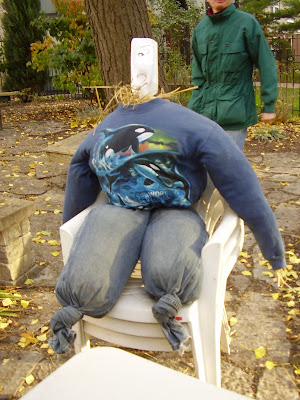


In November, most of our time was spent tidying up the garden to put it in good shape for the spring.

Those jack-o-lanterns we had set out for Halloween looked scarier, if anything, by the following week.


Saturday, November 14 took us over to Garfield Park Conservatory for the Mayor's Landscape Awards (more on that in a separate posting).

And Saturday November 21 was a gloriously crisp and sunny fall day, with time to clean, empty and tidy everything away for the year, and some left over to appreciate the verdant cover crop...


...bursting milkweed pods...


...and a late cosmos bloom.

Saturday, November 14, 2009

Ginkgo wins Chicago gardening award!

On November 14, 2009, which turned out to be a sunny and beautiful autumn day, five volunteers from Ginkgo Organic Gardens attended the awards ceremony for Mayor Daley’s 2009 Landscape Awards. Ginkgo won first place in the vegetable garden category.


Each of the main awards was presented as a sturdy plaque, with details of the award and a photo of the garden in question. Someone at the city's Department of the Environment folks made a good choice in selecting this image for our award. It sums up what Ginkgo is about.


It was great to see so many gardeners from so many different parts of the city and organizations. All sorts of gardens were recognized: from container gardens to school gardens to green roofs and walls to high-rise residential buildings and parking structures and to gardens using only native plants.

Mayor's Award winners

We had a good time talking with William Greer and his wife (whose garden won second place in the vegetable garden category) about their garden and comparing notes about how good the season had been for collards, and strategies for keeping rabbits and squirrels away from our veggies. Check out Mr. Greer's fabulous garden on YouTube.


We also got to eat some rather nice cupcakes.

The ceremony was held at Garfield Park Conservatory, which we happily spent some time exploring after the ceremony. In particular, we were looking for a flower on the vanilla plant, a type of orchid. After much searching we eventually found it dangling from one of the pillars supporting the roof.