Thursday, August 5, 2010

cucumbers

The harvest for the weekend of July 31, 2010 was the most varied of the season so far: a half dozen beets from the planting that finally germinated; the last of the turnips and wax beans; a slightly reduced yield from our trio of greens (collard, kale, and chard); a vibrant collection of tomatoes; a head of cabbage; and a bouquet garni’s worth of herbs.

We also pulled over 39 pounds of cucumbers. One benefit of donating our produce is that we avoid the usual gardener’s challenge of finding people willing to accept cucumbers. (I imagine that right now, shopping bags stuffed with cucumbers are sitting in the break rooms in offices all over the Midwest, perhaps labeled with sticky notes that unnecessarily state that the cucumbers are “Free!”) We grew two varieties of cucumbers this year: the variety with dark green skin that many of us know; and Armenian cucumbers, which are larger and milder, and resemble squash. Like most cucurbits, Armenian cucumbers tend to hide in their beds and to grow to unwieldy proportions.


We still managed to get everything into a single bike trailer, although the cucumbers were a challenge.


The day's volunteers. Gingko's Rule of Volunteer Photographs dictates that someone has to hold a pitchfork. This week was Michael's turn.

Thursday, July 29, 2010

que jardiner c’est apprendre á philosopher

Saturday, July 24 started dewy and overcast, but was sunny and bright by the afternoon. We harvested our first handfuls of cherry tomatoes and a couple of sweet peppers. We pulled a dozen or so turnips, a clutch of carrots, a bucket of cucumber, and a bunch of yellow summer squash. However, the bulk of the day’s harvest—as is usual this time of year—came from our beds of greens: collards, kale, and Swiss chard.


We await ripening cabbages, potatoes, and apples; based on the number of cucumber flowers, we'll soon be awash in gherkins.

While I delivered our produce to the pantry, the others tended the garden. Our pea and wax bean plants had finished for the year, so we composted the plants and prepared the beds for fall crops. We also turned the compost bins and weeded.

Earlier that morning, some of us discussed the garden’s yield to date. Our harvests seem to be smaller than they were the same time last year; in fact, we are concerned that our raised beds may have gradually declined over the last few years. We’re not sure whether the soil in the beds needs amending, whether our seeds were too old, or whether it has been too dry.

Because we have been recording our weekly harvests over the years, we have a body of data that we can interrogate to determine whether our garden’s fertility has, in fact, diminished. I am almost finished with a set of KPI (key performance indicator) charts that we can use for analysis, and which I plan to publish in the blog.

The fact that I use an acronym like KPI hints as to the day job that I generally strive to keep separate from my gardening avocation: compost is compost, and Excel is Excel, and the twain usually don’t meet. However, there is no need to rely on anecdotes when you have three years of data.

----
Je veux…que la mort me trouve plantant mes choux, mais nonchalant d’elle, et encore plus de mon jardin imparfait. —Montaigne, "Que philosopher c’est apprendre á mourir", Essais


Sunday, July 18, 2010

market basket of goods and services

After arriving at the Vital Bridges pantry on Saturday mornings, I arrange the garden's produce as artfully as I can, using baskets that the pantry provides. Just before I wheel out the cart that contains our gussied-up and food-styled donations, I take a few photographs to celebrate the fruits (and vegetables) of our labors.

The other garden volunteers do not usually get the opportunity to see glamour shots of our produce, so these photos are as much for them as for followers of the blog.

The photographs serve as a record of how the offerings of the garden change over the growing season. As spring yielded to summer, our donations changed from radishes and peas to cucurbits, beans, and turnips.

One thing that has not changed (and that shouldn't change for a few more months) is the weekly mess of collards, kale, and chard that we bring. If anything, the amount of collards is increasing.

June 26
: mostly leaves—collards, kale, chard; herbs


July 3
: collards, kale, chard; chives and herbs; radishes; snap peas


July 10
: massive amounts of collards, kale, chard; yellow wax beans; the last of the snap peas


July 17: yellow summer squash, zucchini, and cucumber; lettuce; turnips; yellow wax and green beans. We may need to start using a second cart.


The photos of the cart do not include the bouquets of flowers and containers of fruit that we also bring. During June, we were able to bring in red and black raspberries; last week, we brought gooseberries.


The Ginkgo fleet

The increasing yields from the garden are starting to tax the capacity of the bike trailer that we use to transport produce to the Vital Bridges pantry. On July 10, we were able to load everything into two levels of plastic cartons.


A week later, we had to move to a third level. And this is before the tomatoes arrive.


We are not worried that we will eventually not be able to deliver our produce by bike, for we now have two bike trailers. We anticipate the maiden run of the second member of the Gingko delivery fleet next week.

Wednesday, July 14, 2010

making the earth say beans instead of grass

potato plants in tub
A full month has passed since the last blog entry. In that hot month, the garden has waxed verdant and fecund. You can barely discern our claw foot tub now through its raiment of flowering potato plants, and the dodecahedron bed is a jungle of striving bean tendrils.


Although we've been remiss in our blogging, we have been steadily photographing the garden, and keeping records of our weekend harvests. We'll gradually bring the blog up to date.


For now, though, a few pictures, and an excerpt from Thoreau's essay "The Bean Field":


Removing the weeds, putting fresh soil about the bean stems, and encouraging this weed which I had sown, making the yellow soil express its summer thought in bean leaves and blossoms rather than in wormwood and piper and millet grass, making the earth say beans instead of grass—this was my daily work. As I had little aid from horses or cattle, or hired men or boys, or improved implements of husbandry, I was much slower, and became much more intimate with my beans than usual. But labor of the hands, even when pursued to the verge of drudgery, is perhaps never the worst form of idleness. It has a constant and imperishable moral, and to the scholar it yields a classic result.


Saturday, June 12, 2010

When it rains...we deliver!

Saturday, June 12 dawned grey and murky. Nonetheless, a handful of stalwart volunteers turned out for our second harvest of the season. Not only were the collards going strong


but we also had our first harvest of snow peas (tasty!).


The radishes also continued to flourish.


Of course, once all the produce was weighed and loaded onto Al's bike trailer ready for delivery, the rain bucketed down. Undaunted, Al set out to deliver.


Yes, those vertical lines in the photo are rain.

The rest of us huddled on the porch and wondered whether the rain would stop enough so that we could get some gardening done. Just as we pulled out some gardening books, thinking we would do some research, the rain turned to drizzle, and the gardening commenced.

Al had talked with one of the dietitians at Vital Bridges the previous week and she mentioned that beets were a welcome crop. Our first crop failed to germinate, so we sowed again. Last year, we had beautiful golden beets as well as the more familiar red beets. Here's hoping the new crop germinates.

We also spent some time in the front garden, trying to repair damage to fences done by large dogs or small children. The few fences in the front were put up to try to protect some of the new prairie plants that were put in last fall. Unfortunately, some didn't survive the winter (despite being mulched), and some survived only to be destroyed in the spring. And here's hoping the plants and fences survive.

Saturday, June 5, 2010

our first delivery

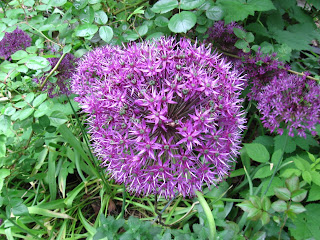
Allium
On May 29, we were worried. We stood at the edge of the dodecahedron bed, looking onto packed dirt irregularly pierced with wooden labels that named beets and beans that we knew would not germinate. We acknowledged our setback—glad that we were weekend farmers and not subsistence ones—and resowed from new packets of seeds. We pulled up the moribund and bolting spinach plants and replaced them with squash seeds. We poked leftover potato sprouts into the spaces that arose between the weakly sprouting rows of plants in their trenches. We tended greens in their muddy rows and hoped for the best.

On June 5, our worries proved to be unfounded. We arrived at the garden to find our new crops vigorous and luxuriant: our collards were especially lush. To our relief, the potatoes had started growing in earnest, and our bush beans had finally received the growth memo. We had crossed that anxious threshold that occurs in the fourth week or so between the sowing of the first seeds and the harvesting of the first crop, when everything is either underground or spindly.

With the assistance of a group of volunteers from Chicago Cares that gamely donned the garden's collection of gamy ponchos against the morning rain, we harvested French breakfast radishes and large leaves of collard greens and kale. We clipped stalks of oregano, sage, and chives from our herb bed. We sheared leaves from the “cut and come again” bed of lettuce under the plum tree. We loaded our harvest into the bike trailer and I left to make the garden's first delivery of the 2010 season.

Three years ago, I started volunteering with Ginkgo both because I was concerned about hunger and because I was interested in learning about organic agriculture. My attachment to the garden has deepened over time because I appreciate the garden’s moral efficiency. While in the garden, we focus on the soil in our raised beds and the plants that live in them, acting on shared commitments and beliefs about ecology and best practices in organic agriculture. When we leave the garden for the food pantry, we act on another commitment that is equally important to us: to provide food of high quality to people who struggle with illness. We connect the health of place to the health of people.

Vital Bridges provides “food, nutrition, housing, case management and prevention services” to people in Chicago who live with HIV/AIDS. For a number of years, Ginkgo has donated the bulk of its produce to the Vital Bridges food pantry in Uptown/Edgewater, on Broadway near Bryn Mawr. Every Saturday during the growing season, volunteers from the garden make a delivery to the food pantry. We arrange our produce in baskets on carts that we wheel into the area where people wait to obtain food from the pantry. When a person in the pantry fills a bag with a handful of collards, or a couple of tomatoes, or a bundle of chives from the garden, she completes a link in which we are happy and honored to participate.

During today’s visit, Lori Cannon, who manages the food pantry, talked to me about the kinds of vegetables that are of interest to the HIV community. Beets, in particular, are important because of their purported ability to cleanse the liver. An increased demand for beets would be just fine with us, because a ripe golden or chioggia beet emerging from damp earth is something we never tire of seeing in the garden.

I returned to the garden to find the other volunteers busy in a variety of tasks. Some of us drilled rows of holes in salvaged logs that will serve as a growth medium for mushroom spores, joining the spores that have already started in piles of straw at the bases of our fruit trees.

Ivy's potato plant Others planted sprouted purple potatoes in bins that we located at the ends of our raised beds. (Ivy, one of our volunteers, has an uncanny ability to sprout potatoes at home: for a couple of weeks, the only potato plants in the garden that appeared to be viable were from spuds that Ivy had originally purchased from the grocery.) Others sprayed soapy water on the undersides of the leaves of our collards and kales to ward off the threat of aphids and thrips.

—
A person who undertakes to grow a garden at home, by practices that will preserve rather than exploit the economy of the soil, has set his mind decisively against what is wrong with us. He is helping himself in a way that dignifies him and that is rich in meaning and pleasure. But he is doing something else that is more important: he is making vital contact with the soil and the weather on which his life depends. He will no longer look upon rain as an impediment of traffic, or upon the sun as a holiday decoration. And his sense of man’s dependence on the world will have grown precise enough, one would hope, to be politically clarifying and useful.

- from “Think Little”, in The Art of the Commonplace: The Agrarian Essays of Wendell Berry