Showing posts with label rhubarb. Show all posts

Wednesday, May 20, 2015

16 May 2015: It's a Garden!

Saturday, May 16th was that first day of the season when I really felt like we transitioned from starting the season to being in the season.  Of course the rhubarb and mint and oregano have been up for weeks, but they do that on their own.  On the sixteenth, we had harvestable heads of lettuce and radishes popping up out of the soil like the instant thermometer on a butterball (only the total opposite of an instant read thermometer on a butterball).  The lettuce and radish are from seeds sown by our volunteers.  Raise your hand if you planted Black Seeded Simpson lettuce! Oh, not you?  What about Red Sails? Surely, you are responsible for the Cherry Belle radishes?  Meanwhile, the Shirz and Penelope peas are making their way up trellises and our greens are looking great!


With regulars and volunteer groups from Second City and Northwestern University Gives Back, we got a tremendous amount of work done on this extended day.  We planted cucumbers. And sure, we planted your regular old slice it in a salad cause you need something crunchy cucumber (yawn), but we also planted Lemon cukes, which look like yellow tennis balls, and Armenian cucumbers (hubba hubba).  We also planted beans (Royal Burgundy and Milk & Cider), watermelon, Patty Pan squash, and a succession of lettuce. 

And that's just the stuff you can eat!  Don't get me started on the geraniums and Inky Fingers coleus.

The season is under way.  Unless we really screw something up, we will bring a harvest to Vital Bridges every week starting this upcoming Saturday and continuing into the late fall. 


Thursday, May 14, 2015

May 2 2015: Blue Devils and Green Comics

On May 2 2015, two groups of volunteers worked together to complete a huge amount of work at the garden. May 2 was DePaul University's 17th Vincentian Service Day, and at least the third time that a large group of students has arrived at the garden ready to help us finish preparing it for the season. The DePaul students, many in blue, were joined by a green-clad group of volunteers from The Second City's Volunteer Team.

After John introduced everyone to the garden and described the tasks that we had planned for the day, he unveiled two pies that he had made using rhubarb from the garden. These pies approached the limits of rhubarb density possible in baked goods.

The Ginkgo Rhubarb Pie
The volunteers set to work. Two teams unearthed the fig trees that we buried last year so that they would survive the winter. The trees looked gray and a little groggy, but they both had already started putting forth leaves.

Digging up Persephone, our larger fig tree

Uncovering Kore, our smaller fig. We shroud the figs in gardening cloth.
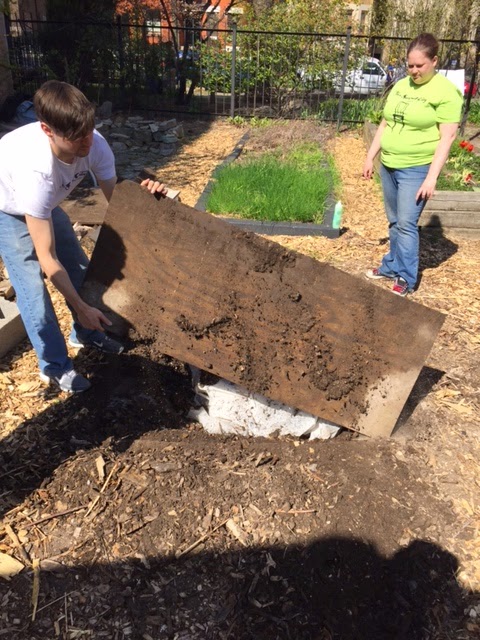
Another team distributed the remainder of the mound of wood chips about the garden, while a smaller group nearby repaired our decrepit back gate.


Kore upright.
After finishing the heavy work, we moved on to planting. Before the start of the work day, we had received a number of flats of kale and cabbage seedlings from Dave, who had started the seedlings using greenhouse space graciously donated by the Center for Green Technology. The kale seeds themselves were made possible by yet another gracious donation from Jill, the mother of our regular volunteer and Chicago Cares coordinator Johanna.

We transplanted the kale seedlings from the flats to our raised beds. After transplanting, we covered our beds with hoop houses: a number of kale pests (including flea beetles) had reached the point in their season when they lay eggs, and we wanted to try to prevent infestation.

We finished up by watering all of the beds and setting up pea trellises.

Thanks to the efforts of our volunteers, the garden was well prepared for the 2015 growing season.


Weeding the beds in preparation for seedlings

After transplanting

Installing hoops for the hoophouses
Beds covered with hoophouses
Cat's cradle pea trellising
Watering radishes

Our volunteers

Tuesday, April 16, 2013

Self Starters

This early in the season we don't have a water hook-up to the city and thus rely exclusively on our rain barrels.  Until these seemingly endless April showers kicked in, this giant ice block is all we had to work with.  Great if you're looking to make a sculpture of a man-eating sea horse, but not so much for watering sprouts.  Empty your rain barrels before winter folks!  Lesson learned.


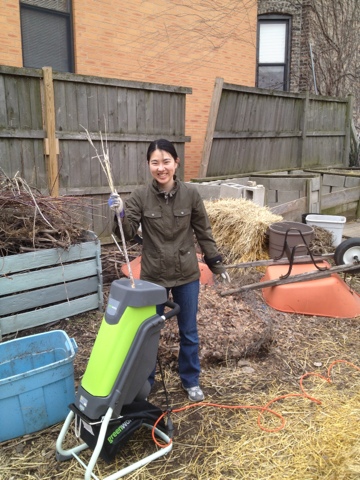
Evelyn demonstrates Ginkgo's new wood chipper.


Despite the lack of water, we are chipper (ba-dum-ching) and our self-starting perrenials have launched the season!

On a side note: this photo will probably be the last of our wooden south facing fence... I can't think of a better photo to show why we are getting a new fence.

Take the rhubarb for example.  By their own will-power these weird alien protrusions begin freaking out volunteers  each spring.  While they currently look like sickly crumpled viscera, soon they will look like pie.  And you wonder why we volunteer.

And without any coaxing we are surprised by the half inch purple nub of an asparagus spear.  This perennial won't yield significant harvests for another couple of years, but it is encouraging to see that it survived year one.


And remember those turnips that never grew last year?  They were in the ground waiting for us early this spring.  The one that I took home was too squishy to eat, but that doesn't make their triumph less remarkable.
While we all look forward to tomatoes that a grocery store could not feasibly stock or finger-staining berries that taste better because you left a little skin in the bramble, spring is brought to us by self starters.  While we fill beds with seeds and transplants, the early risers give us something to look at.  And did I mention, there will be pie.
Frost tolerant volunteers plant potatoes.


Saturday, April 10, 2010

Sneaking into the garden


We sneakily opened the garden a week early for some wonderful volunteers from Chicago Cares. Our favorite volunteer coordinator, Stephanie, was back despite suffering from a terrible cold. And Doug made some lovely muffins for snacking on.

The weather was amazing: warm and sunny and conducive to spending time outdoors. The cover crop, planted at the end of last season, was lush and green in most (but not all) of the beds. The cover crop includes rye, alfalfa and field peas. The alfalfa and field peas are legumes. As they grow, they take nitrogen from the atmosphere during the winter and "fix" the nitrogen into the soil to feed our crops during the growing season. Also, at sowing, the cover crop was inoculated with bacteria known as Rhizobium. These bacteria do the actual nitrogen "fixing". So, as the cover crop grows it replenishes nutrients depleted from the soil during the last growing season.

During our first day back in the garden, the primary mission was to get the beds ready for planting. To do this we trimmed down the cover crop – in some of the beds the crop was about 4 or 6 inches tall! After trimming, volunteers helped turnover the beds, working the crop back into the soil where it will decompose, adding additional nutrients to help support this year’s crops.


Thanks to the hardworking volunteers and the wonderful weather, we were able to sow three beds of spinach (which will be able to tolerate a cold snap, should one come along) and a bed of snow peas (which always do well).


The rhubarb, lovage and sorrell are already growing strong. The raspberries are getting leaves.

This kind soul went out and got water for us to drink as the day proved unexpectedly warm. We’d collected water in the rainbarrel, but that is definitely unsuitable for drinking. And the city hasn’t yet turned on the water for the season.

And these two braved the compost piles, probably turning them for the first time since we put the garden to bed last November (unless someone snuck in over the winter or earlier in the spring, which is a possibility knowing some of our volunteers).


We’re looking forward to preparing more beds next week, although the weather isn’t predicted to be quite as beautiful.

Wednesday, July 1, 2009

Summer's here, and harvests are growing

Saturday, June 27 was a beautiful day in the garden, and a nice group of volunteers picked our largest harvest so far this year: 45 pounds, again mainly greens and herbs, but we also pulled up our first beets (mostly red, but there were a couple of golden).

Together, the beets and turnips made up 15 pounds of the harvest.

Beets and turnips ready to go:


Cart overflowing with greens, beets and turnips, waiting for customers at the food bank:


We also harvested a small amount of rhubarb and some garlic scapes. Garlic scapes are the tender, curled stem of the garlic plant – when diced and added to food, they add garlic flavor without too much heat.

Scapes harvested and ready to be weighed:


The spinach has just about exhausted itself, so the plants were pulled and the bed re-seeded with scallions, more turnips, pole beans and “longstanding” spinach (which does better in hot weather). More beans were sown in one of the beds, since one row hadn’t germinated. And there was lots of watering to do. (Little did we know that a large rainstorm would pass through Chicago on Saturday night – hopefully, it refilled the rain barrel, which has been providing us with lots of water this season).

And there was time to work in the flower beds. Thanks to the Chicago Cares team last week, most of the perennial buttercup is gone, though it is a determined plant and we will probably have to pull up a few interlopers from time to time. Weeding also uncovered some struggling calendula seedlings and a small lavender. We were happy to see that some of the wildflowers sown in the bed near the new patio are starting to appear. And we had time to plant more prairie plants in the front garden, including three small bedstraw plants (Galium boreale) and some Indian grass (Sorghastrum nutans).

Zinnia in one of the flower beds:


Many thanks to Brian and Dave Sh. for this week's photos.