Showing posts with label spring. Show all posts

Monday, May 13, 2013

Our Figgest Day of the Year!

A lot of exciting things happen at Ginkgo, but perhaps the most spectacular is the annual unearthing of the fig trees.  On May 11th our volunteers set to work digging gingerly and bringing the trees back up into daylight.

For those that are unclear, let's review:

Figs like ours are typically found in the Mediterranean where the winters are mild and no one puts lawn chairs in parking spots that they spent 45 minutes shoveling out.  We insulate our figs against this harsh winter by burying the trees around Halloween.  We wrap the trees, dig a large hole beside each one, dig around the root balls and tip the trees down into the holes while trying to maintain the long, vital, tap root.  Following this, we lay something sturdy (plywood) across the hole and cover it with soil to keep an insulated even temperature in the chamber below ground.  We then dig up the trees in spring, water and wait for delicious fruit.

During this process last fall we had to make a rather drastic cut to the tap root of our larger fig tree in order to bend it into the ground.  There is a lot of anticipation concerning the consequences of that cut, but when we dug it up, there were signs that the tree was going to make it.  Fruit continued to grow, even below ground, and new growth was evident.

The meretricious draw of figs should be enough to lure you to the garden this season, but until they have begun to fruit, our lilacs will drive you wild. 


Wednesday, May 1, 2013

In Bloom

Spring was best described by Kurt Cobain who said, "Sell the kids for food.  Weather changes moods.  Spring is here again." ba da-da-dada-ahem!  While Cobain's words are often unintelligible, the blossoms on our ornamental cherry tree are well pronounced.

Was Saturday the 28th so beautiful because flowers were opening? Was it because we had gorgeous weather?  Maybe it was because we had an excellent and curious crop of volunteers.  Whatever the reason or combination thereof, it felt like spring and it felt good.

Volunteers worked to plant more early season seeds and we transplanted some of our hardier greens (Don't mistake this optimism for naivety.  We're not out of frost danger just yet).  Aside from planting, volunteers including a great group from Chicago Cares, calculated the dimensions of some of our beds so that we can update Ginkgo's site map.  We also began construction on our new compost system by cutting cedar 2x4s left over from the fence.  Another ambitious team helped to transfer finished compost from the existing bins to the beds.  They were able to empty the bin, a task that was impossible even a week ago because the pile was frozen.

The smell of warm dirt mingling with cedar  and cherry blossom might, after all, have been the reason why Saturday was a perfect day in the garden.


Tuesday, April 16, 2013

Self Starters

This early in the season we don't have a water hook-up to the city and thus rely exclusively on our rain barrels.  Until these seemingly endless April showers kicked in, this giant ice block is all we had to work with.  Great if you're looking to make a sculpture of a man-eating sea horse, but not so much for watering sprouts.  Empty your rain barrels before winter folks!  Lesson learned.


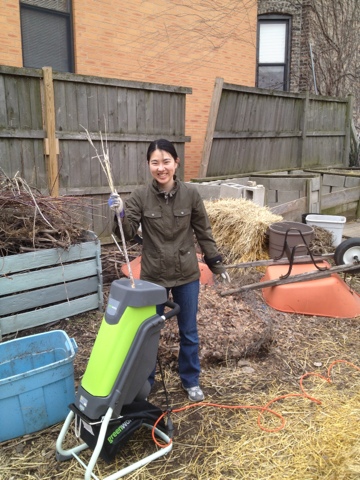
Evelyn demonstrates Ginkgo's new wood chipper.


Despite the lack of water, we are chipper (ba-dum-ching) and our self-starting perrenials have launched the season!

On a side note: this photo will probably be the last of our wooden south facing fence... I can't think of a better photo to show why we are getting a new fence.

Take the rhubarb for example.  By their own will-power these weird alien protrusions begin freaking out volunteers  each spring.  While they currently look like sickly crumpled viscera, soon they will look like pie.  And you wonder why we volunteer.

And without any coaxing we are surprised by the half inch purple nub of an asparagus spear.  This perennial won't yield significant harvests for another couple of years, but it is encouraging to see that it survived year one.


And remember those turnips that never grew last year?  They were in the ground waiting for us early this spring.  The one that I took home was too squishy to eat, but that doesn't make their triumph less remarkable.
While we all look forward to tomatoes that a grocery store could not feasibly stock or finger-staining berries that taste better because you left a little skin in the bramble, spring is brought to us by self starters.  While we fill beds with seeds and transplants, the early risers give us something to look at.  And did I mention, there will be pie.
Frost tolerant volunteers plant potatoes.


Sunday, April 24, 2011

three weekends in April


Julie and Nick pull up kale stalks
The morning of April 2 started cool and overcast, with clouds that eventually made good on their threats to rain on the trio of us that gathered at the garden to prepare the garden for spring. Julie, Nick, and I cleared the kale beds of old stalks, removed wire fencing, and picked up trash.

Meanwhile, a few miles to the west of the garden, Dave Snyder started our seedlings in the greenhouse at Kilbourn Organic Garden. Kilbourn grants us greenhouse space each spring, so garden volunteers do not have to crowd narrow apartment windowsills with precariously balanced rows of pots of seedlings.

April 9 was the first volunteer day of the season. A group from Chicago Cares joined us, as did a group from DePaul Oxfam. At one point, I counted twenty-six people in the garden, all of who looked to us for instructions.

Doug and Ben

During the winter, the small group of volunteers that (for want of a better term) refers to itself as the garden’s “steering committee” agreed to define formally three positions that would need to be filled each Saturday workday. The positions would rotate among the steering committee members so that we wouldn’t tire of them. I once described the positions as the Lover, the Foreman, and the Driver; word-besotted folk that most of us are, though, we already have a number of alternate names.

The Lover, or Der Spielmacher, serves as the guide to the garden and to gardening, giving the Ginkgo spiel to new volunteers—what the garden is, how it works, who it helps, what our yield is, etc. Aside from welcoming volunteers, the Spielmacher’s responsibilities teaching volunteers how to perform tasks like staking tomatoes and weeding correctly, as well as wearing the floppy garden hat and helping people to enjoy what they’re doing.

Spielmacher Dave and the April 2 volunteer crew
While the Spielmacher is helping volunteers grok the garden, the Foreman is running crews. The Foreman prepares the list of the day’s objectives and assigns groups of volunteers. The Foreman also maintains what little discipline we need, asking people to walk around instead of in the beds, pick up tools, etc.


pulling up last year's wildf
We won’t need someone to be a Driver for a few weeks. When we start harvesting, though, one of us will assume the responsibility of packing and delivery of produce to the pantry. The Driver winds up serving the additional role of liaison between the garden and the pantry.

On April 9, Dave Snyder was the Speilmacher and I acted as Foreman. Our volunteer group raked leaves, weeded beds, organized the shed, and cleaned up the garden. Because we had so many people, we needed only a couple of hours to make the garden neat and ready for the season.
raking in the front garden
weeding the dodecahedron

Stephanie's lemon cupcakes in their special purpose cupcake holder
On April 16, Susan and Evelyn worked with a group of eight volunteers. Sue summarized the day’s work in an email:


We did some more cleaning and weeding, smoothed out a big hump of compacted soil that I've tripped on right by the shed (it was a big job!), inventoried tools (to facilitate tool return at the end of the workdays....) and shelled various leftover seed pods in the shed to prepare for the new plantings.


The following Saturday, April 23, Dave led volunteers in unearthing the fig trees that we buried last fall to spend the winter underground. The figs look spindly right now after their hibernation, but should soon recover. One of the saplings produced small fruits last fall, so we might even be able to harvest figs this year.